Publishers
How Ads Impact Core Web Vitals (CWV): A Technical Guide
Megan Rhein
Updated On:
April 13, 2026
LAUNCH YOUR FIRST REVCONTENT CAMPAIGN TODAY
Sign Up
Get in touch with our team
Contact Us.png)
Core Web Vitals (CWV) have become a defining benchmark for publisher performance, influencing everything from search visibility to user engagement and revenue outcomes. Yet for many publishers, the biggest driver of poor CWV scores isn’t their content or design – it’s their ad stack. In this article, we’ll break down how ads directly impact Core Web Vitals (LCP, INP, and CLS), walk through how to audit your current setup, and outline the technical best practices and partner considerations needed to improve performance without sacrificing monetization.
Why Core Web Vitals Are Critical for Publisher Performance
Core Web Vitals are critical performance metrics that directly impact page speed, user experience, and revenue. For publishers, understanding how ads impact Core Web Vitals is essential to maintaining both visibility and monetization.
The three Core Web Vitals metrics publishers must optimize are:
- Largest Contentful Paint (LCP): Measures how quickly the main content loads.
- Interaction to Next Paint (INP): Measures responsiveness.
- Cumulative Layout Shift (CLS): Measures visual stability.
How Ads Impact Core Web Vitals (LCP, INP, CLS)
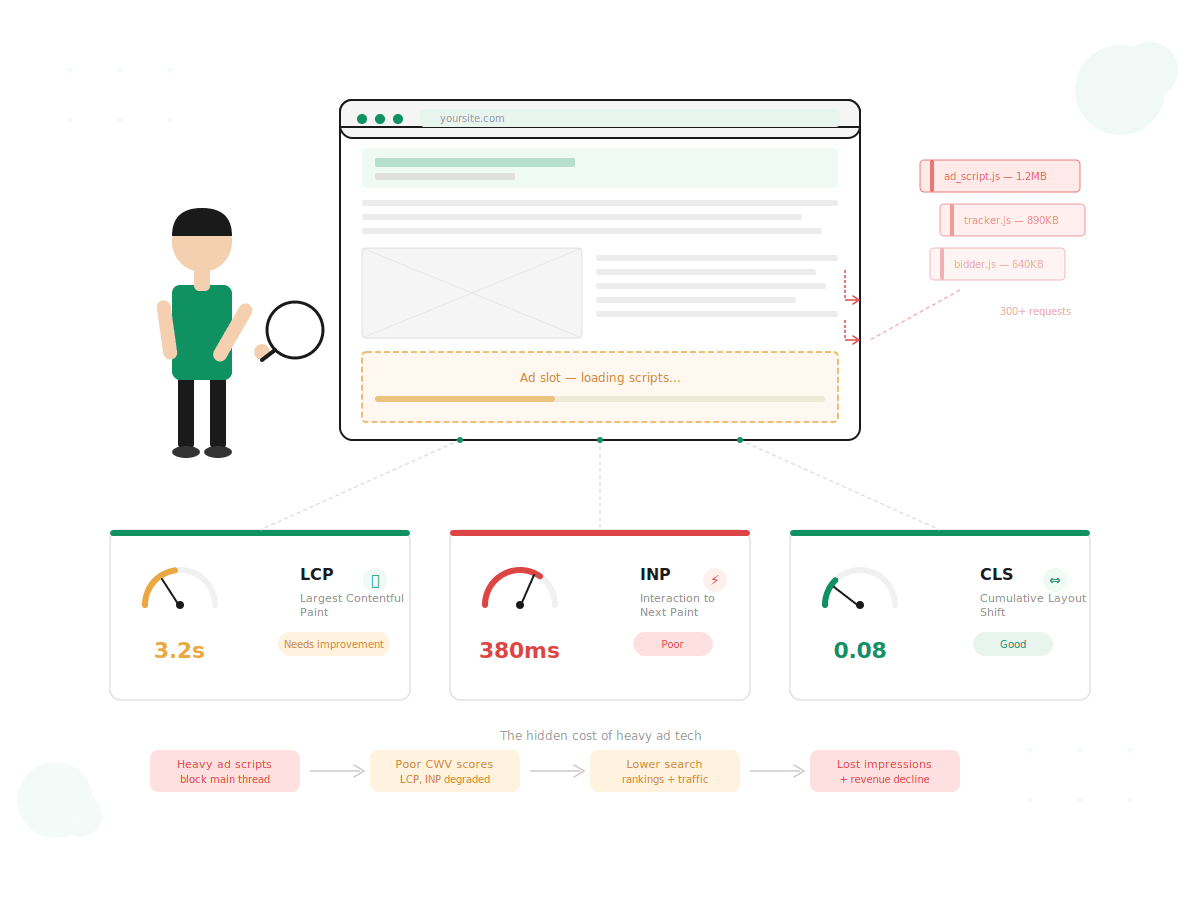
Ad tech is one of the biggest drivers of poor Core Web Vitals performance. Understanding how ads impact LCP, INP, and CLS is key to improving page speed.
LCP: How Ad Requests Slow Page Load Speed
Header bidding and multiple ad calls can delay rendering of the page’s main content. This directly increases LCP and slows perceived load time. In some cases, ad scripts can exceed 1.6MB and trigger 300+ network requests, significantly impacting page speed.
INP: How Third-Party Scripts Hurt Responsiveness
Third-party ad tech often runs on the main thread, blocking user interactions. According to DebugBear, third-party scripts are one of the largest contributors to poor web performance, making them a major factor in degraded INP scores.
CLS: How Ads Cause Layout Shift
Ads that load dynamically without reserved space cause layout instability, negatively impacting CLS. Google identifies reserving ad space as a key best practice for improving Core Web Vitals and preventing layout shift.
How to Audit Your Ad Stack for Core Web Vitals (CWV)
To improve Core Web Vitals, publishers must first measure how their ad stack impacts performance.
1. Measure Core Web Vitals with Lighthouse
Use Lighthouse and PageSpeed Insights to identify:
- Poor LCP elements
- Layout shifts (CLS)
- Render-blocking scripts
2. Identify Slow Ad Scripts in Chrome DevTools
Analyze the below to help pinpoint which ad partners are impacting Core Web Vitals:
- Long main-thread tasks
- Script execution time
- Layout shift sources
3. Compare Performance With and Without Ads
Using tools like SpeedCurve, test the following to reveal the true cost of your monetization setup.
- Full ad stack vs. reduced scripts
- Third-party impact on CWV metrics
Improving Core Web Vitals is not just about performance; it directly impacts revenue.
Google research shows that as page load time increases from one to three seconds, the probability of bounce increases by 32%, highlighting how even small delays can significantly reduce user engagement.
Poor Core Web Vitals also have a direct impact on monetization. When pages load slowly, users are more likely to leave before ads fully render, resulting in missed impressions and lost revenue.
Additionally, broader industry data shows that improvements in Core Web Vitals are consistently tied to better engagement and stronger revenue performance across publishers.
Best Practices to Improve Core Web Vitals with Ads
To improve Core Web Vitals without sacrificing revenue, publishers should adopt performance-first ad strategies:
- Asynchronous ad loading
- Lazy loading for below-the-fold ads
- Reserved ad slots to prevent CLS
- Reduced JavaScript payloads
- Minimal main-thread execution
These techniques are recommended by Google to reduce the impact of ads on page speed.
Choosing Ad Partners That Improve Core Web Vitals
Not all ad tech is optimized for Core Web Vitals. When evaluating partners, prioritize:
- Lightweight ad delivery
- Async-first architecture
- Minimal script footprint
- No layout shift behavior
- Transparent Core Web Vitals impact
Publishers should prioritize partners that are built for performance and not retrofitted to fix performance issues later.
How RevContent Improves Core Web Vitals (CWV)
RevContent is built with a fundamentally different approach to monetization – one where performance is not an afterthought, but a core product principle. While many ad solutions attempt to optimize around heavy infrastructure, RevContent is designed from the ground up to minimize the performance impact of ads and protect Core Web Vitals.
This performance-first architecture translates into measurable advantages for publishers:
- 60% faster widget performance than competitors, enabling faster render times and reduced latency across the page
- A lightweight, cookieless architecture that eliminates unnecessary tracking overhead and reduces JavaScript payload
- No impact on page load speed by design, avoiding the common tradeoffs seen with traditional ad tech
- A monetization model where revenue is driven by performance—not at the expense of user experience, aligning business outcomes with CWV optimization
- A more efficient programmatic approach, reducing unnecessary bid requests and limiting the strain on the browser
The result is a monetization solution that works with your site performance – not against it. Instead of introducing additional complexity and degradation, RevContent helps publishers maintain fast, stable, and responsive experiences while continuing to scale revenue.
In an ecosystem where many partners contribute to performance issues, choosing one that actively reduces that burden can have an outsized impact. Contact us today to discuss how RevContent can help you improve Core Web Vitals and unlock more efficient, sustainable revenue growth.
Looking Ahead: Addition by Subtraction
In the next post, we’ll explore how switching your content recommendation partner can completely transform your site.


.png)